Every workout in GainGames is made of blocks, and every block has a format. There are 9 formats in three groups. The group decides how the work counts.
Lifting
These count like any other lifting. Each working set adds to your muscle rings and earns set XP.
- Sets: straight sets, one exercise at a time. This is what you get when you tap Add Exercise.
- Superset: two or more exercises back to back, then rest.
- Circuit: three or more exercises in a row, then rest.
Supersets and circuits are logged in rounds. Each round has one set of every exercise in the block, and you can set a rest after each round.
Conditioning
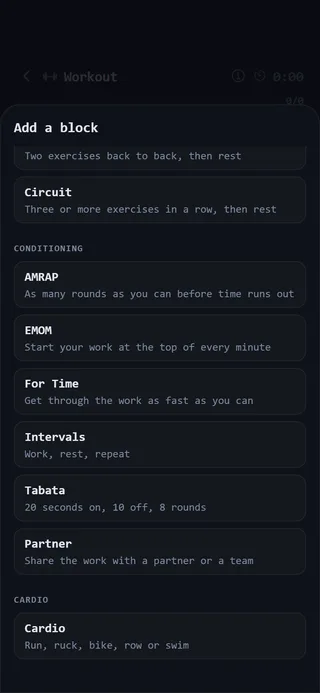 Conditioning and cardio formats on the Add a block sheet.
These run on a clock. You tap Start when you begin.
- AMRAP: as many rounds as you can before time runs out. You tap +1 round as you go and enter any Extra reps at the end.
- EMOM: start your work at the top of every minute. All exercises can go each minute, or they can take turns.
- For Time: get through the work as fast as you can. You can set rounds or a rep ladder like 21-15-9, and an optional time cap.
- Intervals: work, rest, repeat, with the times and rounds you choose.
- Tabata: 20 seconds on, 10 off, 8 rounds.
Conditioning counts toward your conditioning ring in effort minutes. An effort minute is a minute scaled by how hard you worked: easy minutes count half, moderate count once, and hard minutes count double. Conditioning blocks start at Hard, and you can change the intensity.
If a conditioning block is really strength work, turn on Strength work. Its sets then count toward your muscle rings, and its minutes still count toward conditioning. It earns XP for its sets, not its minutes, so the same work is never paid twice.
Conditioning blocks also keep a benchmark. The first time you do a block sets your baseline. Beat your best on the exact same block later and you earn 50 XP, once a week per block.
Cardio
- Cardio: run, ruck, bike, row or swim. You log the type, duration and, if you have it, distance. Cardio counts toward the conditioning ring in effort minutes, like conditioning blocks do.
Why the groups matter
Your muscle rings are built from hard sets, so only lifting work fills them. Timed and rounds-based work is measured better by time and effort, so it fills the conditioning ring instead. Keeping the two apart means a long circuit can’t make a muscle look trained when it wasn’t, and a heavy lifting day can’t pass for cardio.