A personal record, or PR, is your heaviest weight for a given number of reps on an exercise. GainGames keeps 16 of them for every exercise, so a heavy single and a hard set of 10 each get their own record.
The 16 rep ranges
Every rep count from 1 to 11 has its own record. Above that, the ranges get wider: 12 to 14, 15 to 19, 20 to 29, 30 to 49, and 50 or more.
A set counts toward the highest range at or below its reps. So a set of 13 counts in the 12 to 14 range. Rounding down means a record never claims more reps than you did.
Records carry down
A heavier lift at more reps also counts at fewer reps. If you lift 100 for 8, that fills your 5-rep record too, if your 5-rep record was lighter. It never works the other way. That’s why a set can fail to be a PR even when its range looked empty: you’d already beaten it with more reps.
Ties
Records compare weight first. If the weight is the same, the set with more reps wins. That matters inside the wider ranges: 45 for 14 beats 45 for 12, even though both land in the 12 to 14 range.
Which sets can count
- Warm-up sets never count. Mark a set as a warm-up by tapping its number before you check it off.
- Only completed sets count. Timed and distance sets don’t set rep records. They have their own, in the next section.
- Drop sets count once, through the first set of the drop.
- Bodyweight exercises use the added weight. A pull-up with 25 lb added is compared as 25. A bodyweight set with nothing added doesn’t enter the weighted records. Instead, GainGames tracks your most reps at bodyweight on its own. Assisted sets don’t set either kind of record.
Holds, carries and calorie rounds
Timed and distance work sets records too.
- Holds (a plank, a dead hang) keep your longest time. A hold with weight added is a record when no earlier hold was both as heavy and as long, and a heavier hold has to last at least 10 seconds to count.
- Carries and sleds are judged on weight and distance together. A set is a record when no earlier set was both as heavy and as far. A heavier set has to go at least 10 meters to count. Going farther at the same weight, or at a lighter one, has no minimum. With no weight added, it’s just your farthest set.
- Calorie rounds (an Air Bike, a rower or a ski erg in an Intervals or Tabata block) keep the most calories you got in one round, for each machine and each round length. A 20-second round is only compared with other 20-second rounds. The number is the one on the machine’s screen, typed in once the block is done.
The first time you do any of these, it sets the number to beat. It isn’t a record yet. Warm-up sets and drop sets never count. A plank inside a block with Strength work turned on counts like any other plank.
Each exercise’s page shows your best at the top, then your best at each weight or round length.
When you find out
PRs are checked as you go. When you check off a set that beats your record, you get a celebration straight away, and the set is marked with a crown. Each new record also earns 50 XP when you finish the workout.
Where to see them
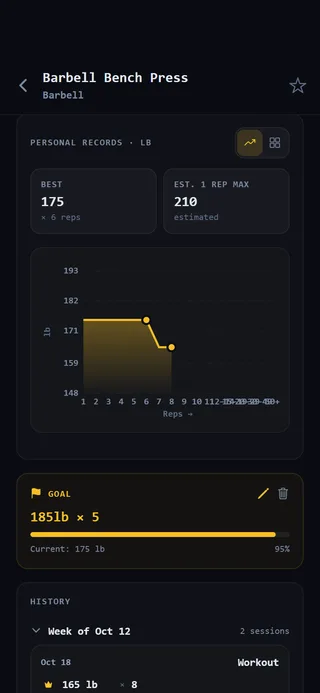 An exercise’s records, strength curve and goal.
Open the Progress tab and select PRs at the top. You’ll see your Recent PRs first. Tap an exercise to see its records as a strength curve and as a grid of every rep range.
When records change
If you edit or delete a past workout, your records are recalculated from what’s left. A record set by a deleted workout goes back to your next best.
Cardio and conditioning
Cardio has its own records, like your longest session of each type, your fastest mile, 5K and 10K, and your heaviest ruck. Conditioning blocks keep a benchmark best for each exact block you repeat, and can also set a calorie-round record, as above.